Burst Web Platform on GKE
Overview
Burst Web Platform on GKE adds warm cloud capacity to a public service without changing its hostname or delivery model. The burst origin stays ready in advance, and traffic moves only when the control plane calls for it.
The scenario focuses on event-driven capacity expansion while the primary service remains authoritative.
Case study
- Context: the public web platform served from a single origin with no mechanism to add cloud capacity without changing the public hostname or taking a service cut during the transition.
- Challenge: burst capacity had to be ready before the event. Provisioning under pressure was not an acceptable operating model.
- Approach: GKE hosts the burst origin via
gcp/gke-burst@v1. Cloudflare steers the same hostname (burst.hybridops.tech) between primary and burst origins. A decision service evaluates pressure and health signals before changing traffic state. Return to primary is an explicit operator action once pressure clears. - Outcome: the recorded burst exercise completed cleanly. Traffic steering was confirmed via
traffic.status: live-ok, the burst origin was verified before the event, primary service was restored cleanly after, and the hostname remained unchanged throughout.
Shows the Grafana event view, the decision-service trigger, same-host steering into burst capacity, and the controlled return to primary.
Outcome
The result is a public web platform that can add capacity without changing its address or identity.
- One public hostname remains in use throughout the event.
- Burst capacity is activated under measured pressure instead of being left to an unplanned cutover.
- Traffic returns to primary through an explicit, reviewable control action after the event.
Operating model
This is a warm burst model.
- Burst capacity is provisioned before the event and verified in service.
- Cloudflare steers the same hostname between the primary origin and the burst origin.
- Decision service evaluates the relevant signals before traffic state changes.
- Return to primary is explicit and reviewable once pressure clears.
The pattern focuses on the public edge and control path for services that need short-duration capacity expansion behind one public front door.
Architecture
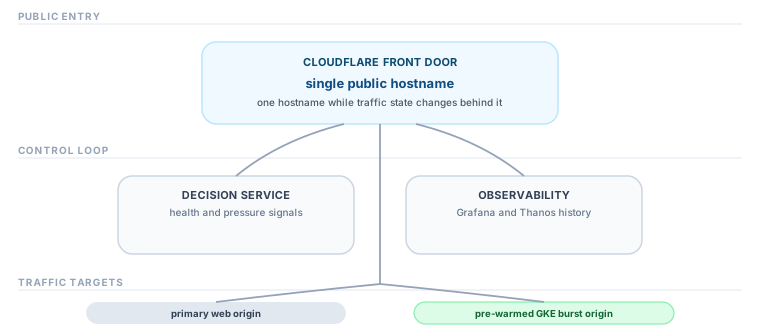
The traffic plane and control plane remain separate. Users keep one public hostname while the decision service changes origin steering from observed pressure and health signals; the GKE origin is already warm and verified before it receives production traffic.
Activation sequence
- The primary origin serves normal traffic on the shared hostname.
- Observability and probes detect pressure or degraded service conditions.
- Decision service shifts the shared hostname into balanced delivery.
- The burst origin absorbs capacity, then traffic returns to primary through the declared control path.
Platform state
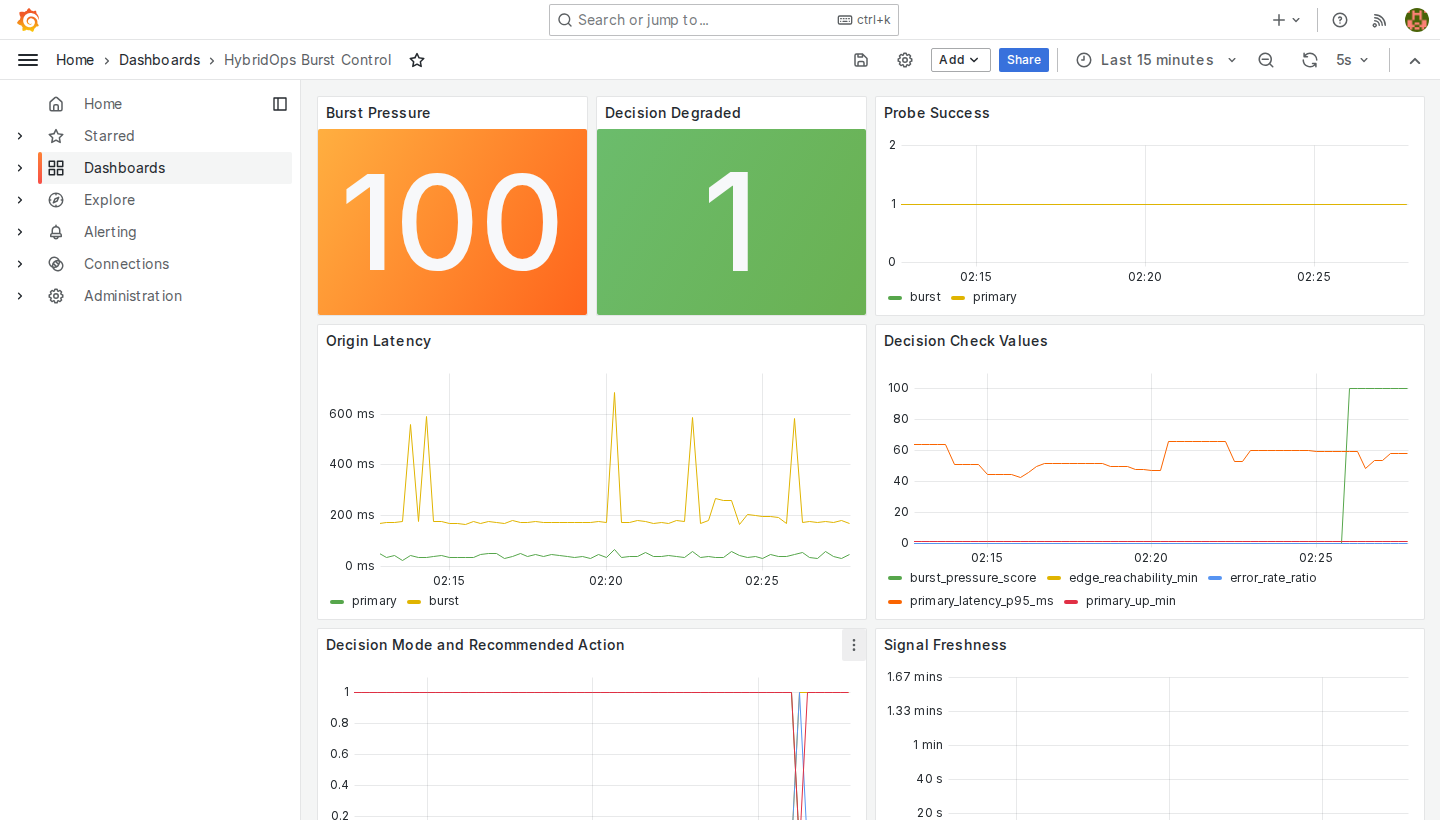
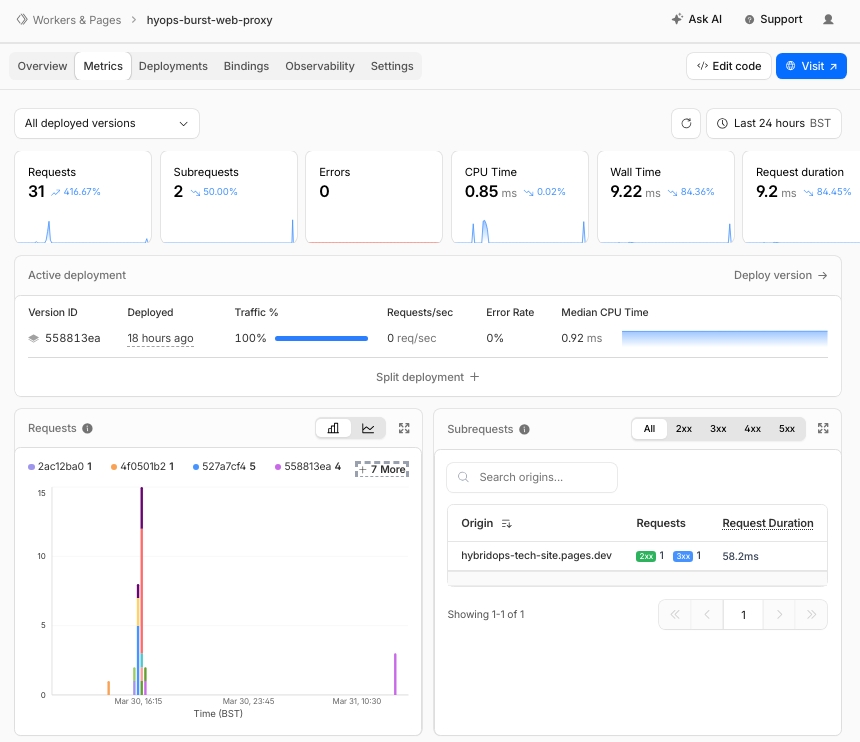
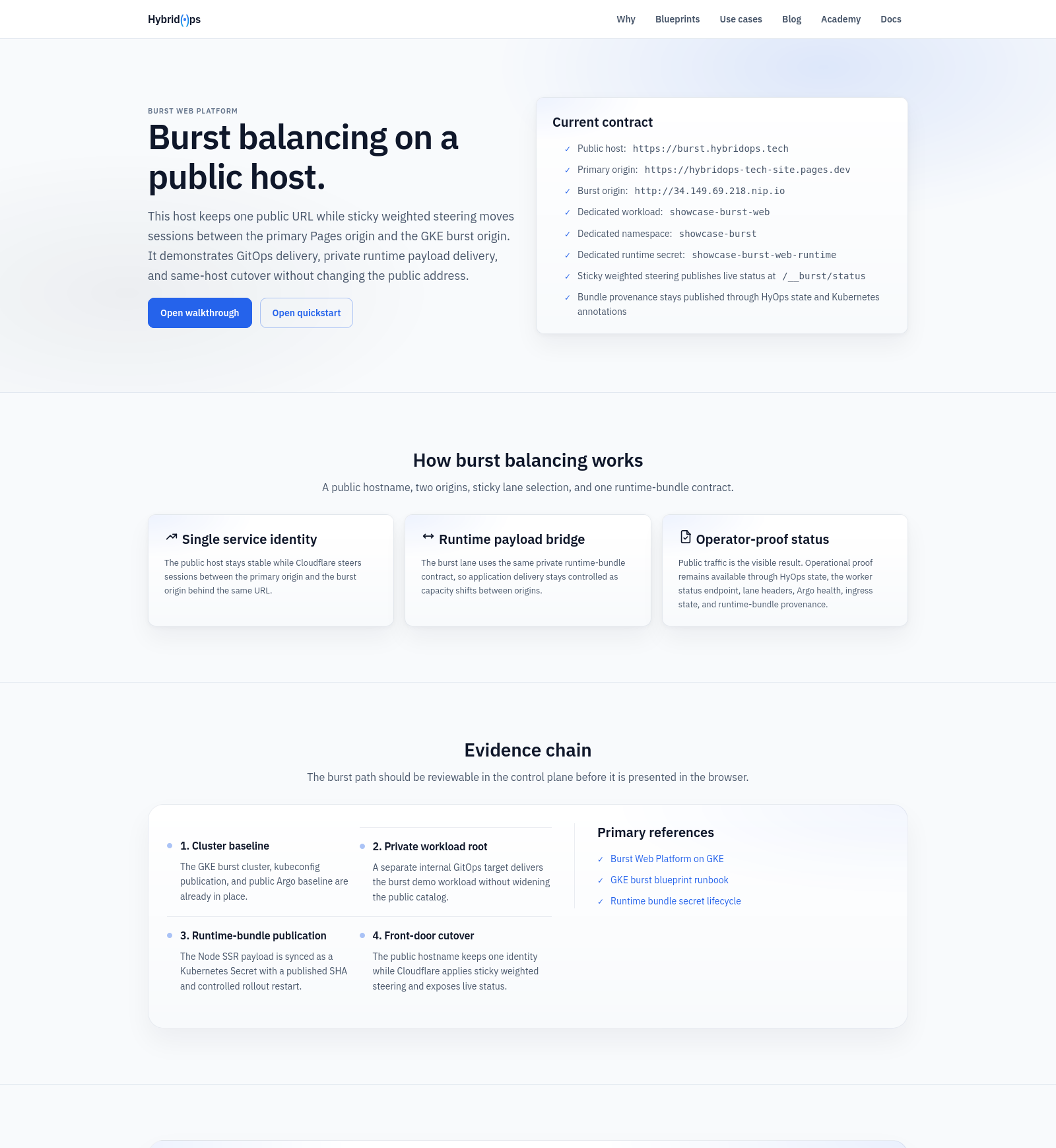
IP addresses, hostnames, and instance identifiers visible in screenshots and recordings reflect the ephemeral infrastructure provisioned during the recorded exercise.
| Component | Module | Last run | Status |
|---|---|---|---|
| GKE burst cluster | platform/gcp/gke-cluster#gke_burst_cluster |
2026-03-18T11:54:47Z |
ok |
| Argo CD bootstrap | platform/k8s/argocd-bootstrap |
2026-03-20T23:59:23Z |
ok |
| Runtime bundle delivery | platform/k8s/runtime-bundle-secret |
2026-03-21T00:07:25Z |
ok |
Run records are retained as part of the platform execution log for review and audit.
Implementation
- Burst workload: GKE hosts the burst origin.
- Traffic control: Cloudflare keeps one public hostname while applying the steering policy.
- Control loop: decision service acts on observed pressure and health conditions.
- Observability: Grafana and Thanos provide the operator view of control state and signal history.
- GitOps discipline: the public and private workload paths remain separately managed.
- Runtime delivery: private application payloads are delivered through the runtime-bundle path rather than being mixed into the public docs surface.
Key components
- Burst baseline blueprint:
gcp/gke-burst@v1 - Front door steering:
platform/network/cloudflare-traffic-steering#showcase_burst_balancer - Decision control:
platform/network/decision-service - Observability:
platform/network/edge-observability - Public GitOps root:
platform/k8s/argocd-bootstrap#gke_burst_gitops - Private GitOps root:
platform/k8s/argocd-bootstrap#gke_burst_web_gitops - Secret store bootstrap:
platform/k8s/gcp-secret-store#gke_burst_secret_store - Runtime payload delivery:
platform/k8s/runtime-bundle-secret#showcase_burst_web_runtime_dev_burst
Where it fits
- customer and partner portals
- launch and campaign traffic spikes
- product documentation and public web surfaces
- hybrid delivery patterns where the public edge must move first
References
Further reading
Implementation references
platform/network/cloudflare-traffic-steering#showcase_burst_balancerplatform/network/decision-serviceplatform/network/edge-observabilityplatform/k8s/argocd-bootstrap#gke_burst_gitopsplatform/k8s/argocd-bootstrap#gke_burst_web_gitopsplatform/k8s/runtime-bundle-secret#showcase_burst_web_runtime_dev_burst
Related
Related reading
- GKE Burst Baseline (HyOps Blueprint)
- Runtime Bundle Secret Lifecycle (HyOps Module)
- Hybrid Portal Burst to GKE
What was verified
Verified during the recorded HybridOps v1.0.1 burst exercise with same-host traffic steering, authenticated observability, decision-service state, and a clean return to primary.